
Direct answers
| Question | Short answer | Source |
|---|---|---|
| What is an earnings claim? | Any statement or image that tells people how much they can earn. It can be stated outright or implied. | FTC staff guidance |
| Do lifestyle posts count? | Yes. FTC staff treat pictures of houses, cars and vacations as implied earnings claims. | FTC staff guidance |
| Does "results not typical" fix a claim? | No. FTC staff say that kind of disclaimer is not enough. | FTC staff guidance |
| Is the company responsible for field posts? | Generally yes. The FTC says companies can be held liable for their distributors' deceptive marketing. | FTC Business Blog, June 16, 2026 |
| Is there a federal earnings claim rule for direct selling? | Not a final one. The FTC proposed a rule on January 13, 2025. Its page for that notice still showed it as proposed when checked on November 16, 2026. | FTC notice |
This guide is for home-office teams who write the rules for field posts and for the people who review them. It covers US rules and US industry self-regulation. It is general information, not legal advice.
What counts as an earnings claim
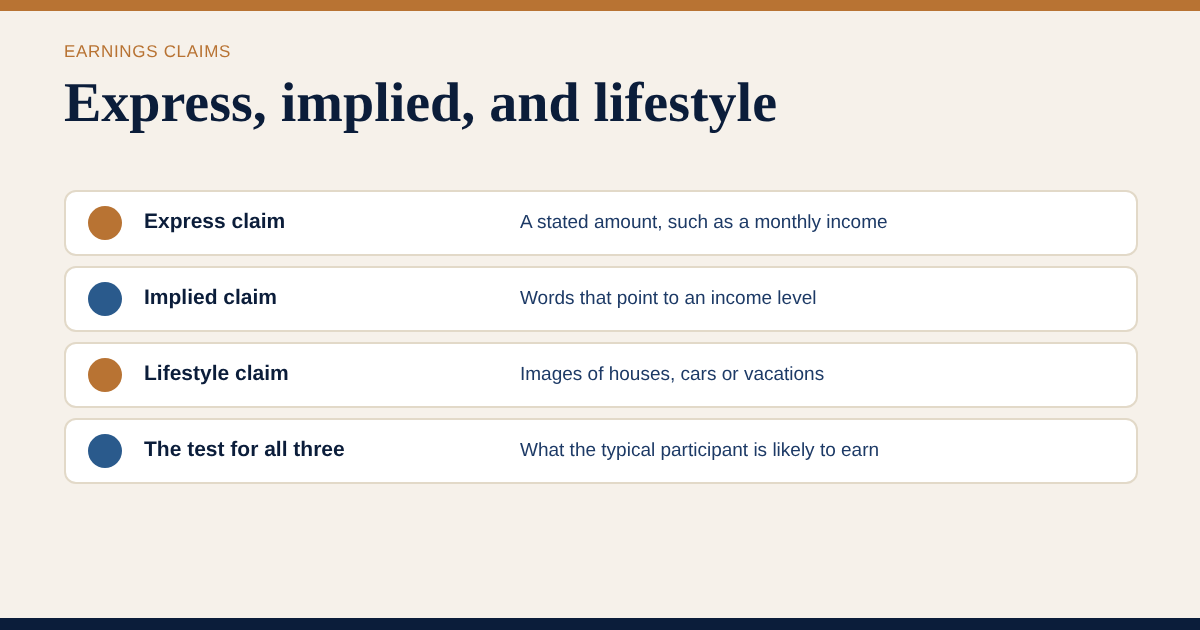
An earnings claim does not need a dollar figure. FTC staff guidance describes three kinds (Business Guidance Concerning Multi-Level Marketing, questions 13 and 15):
- Express claims. A stated amount, such as a monthly income or a bonus total.
- Implied claims. Words that point to an income level without a number, such as replacing a job or paying off debt.
- Lifestyle claims. Images of houses, cars or vacations. FTC staff treat these as implied earnings claims, and as deceptive when participants generally do not achieve those results.
Industry guidance gives similar examples. The Direct Selling Self-Regulatory Council lists phrases such as "be set for life" and "financial freedom", success stories that do not reflect what most participants experience, and claims that leave out the mandatory costs of taking part (DSSRC earnings claims guidance announcement).
In a party plan business, the claim is as likely to sit in a consultant's reel or a recruiting graphic as in a home-office brochure. The same test applies to all of them.
What the FTC expects
The FTC enforces the general ban on unfair or deceptive practices. Its staff guidance on multi-level marketing was last updated in April 2024. It is non-binding staff guidance, but it shows how staff read the law (FTC staff guidance).
- Claims should match typical results. An earnings claim should reflect what the typical person in the audience is likely to earn (questions 13, 17 and 18).
- You need evidence first. A reasonable basis means reliable, empirical evidence, not personal belief or a few stories. Staff say a marketer without that data should make no earnings claims.
- Count the expenses. Claims have to account for costs such as product purchases, travel, tools and training (questions 13 and 14).
- Disclaimers do not rescue a claim. "Results not typical" is not enough. A needed disclosure has to be clear, prominent and next to the claim, not behind a link, and it cannot cure a misleading overall impression.
The FTC repeated the core points in a June 16, 2026 business blog post: be able to back up earnings and lifestyle claims, do not use a few high earners to suggest others will match them, and base claims on what a typical participant is likely to earn (FTC Business Blog).
Who is responsible for field posts
Both the company and the person posting. The June 2026 FTC post says companies can be held liable for their distributors' deceptive marketing, and that distributors who recruit with income claims can be held liable for those claims (FTC Business Blog).
The staff guidance goes further (questions 27 and 28). It says a company is generally liable for participants acting as its agents even when it tried to prevent the violation, and that there is no safe harbor. It lists what staff expect a company to do:
- Train participants on what violates the law.
- Monitor participants and apply meaningful discipline.
- Require approval of income and product claims before they are used.
- Collect copies of advertising, including private chats and video calls.
- Have access to the social media groups where participants discuss the business.
Staff add that these measures have to work in practice. A policy nobody enforces does not count.
Where the proposed federal rule stands
On January 13, 2025 the FTC issued a notice of proposed rulemaking for an "Earnings Claim Rule Regarding Multi-Level Marketing" (FTC notice). As proposed, the rule would:
- Prohibit misleading earnings claims.
- Prohibit earnings claims made without substantiation.
- Prohibit presenting the opportunity as employment.
- Require a company to give its substantiation to anyone who asks for it.
A companion advance notice asked whether the rule should go further, for example with a required earnings disclosure or a waiting period.
Status: the FTC's page for the notice still listed the rule as proposed when we checked it on November 16, 2026. The page showed no final rule and no withdrawal. Until that changes, the law that applies is the FTC Act's general ban on deceptive practices, read through the guidance above.
Industry self-regulation
Direct Selling Self-Regulatory Council
The Direct Selling Self-Regulatory Council (DSSRC) is run by BBB National Programs. On July 9, 2020 it released its Guidance on Earnings Claims in partnership with the Direct Selling Association (DSSRC announcement). The announcement says the guidance covers:
- What qualifies as a misleading earnings claim.
- A company's responsibility for claims made by its salesforce.
- What happens when DSSRC identifies a misleading claim.
- Recommended practices for avoiding a self-regulatory challenge.
DSA Code of Ethics
Section 8 of the Direct Selling Association Code of Ethics says a member company may not misrepresent the actual or potential sales or earnings of its independent salespeople, and that earnings and sales claims have to rest on documented facts. Member companies must require their salespeople to meet the Code's standards. The Code is not law (DSA Code of Ethics).
The copy on the DSA site is marked as amended by its board through December 13, 2018. Read that page before you quote the Code in a policy.
Income disclosure statements and "typical results" wording
Many companies publish an income disclosure statement and point to it from field posts. FTC staff guidance says a statement should (questions 23 and 24, FTC staff guidance):
- Include participants who lost money or earned nothing, not only "active" ones.
- Report income actually earned in the period, without annualizing or projecting.
- Explain clearly what data it contains, with the key figures easy to see.
There is disagreement here that home offices should know about. DSSRC published guidance on income disclosure statements in fall 2023. In a letter dated March 15, 2024, FTC staff told DSSRC they had serious concerns about that guidance (FTC staff letter, PDF). Following industry guidance on these statements does not by itself satisfy FTC staff.
A link to an income disclosure statement does not repair a post that gives the wrong impression. The post has to be accurate without it.
A home-office checklist
- Write the rule in plain words. No income figures, no "replace your job", no lifestyle photos tied to the opportunity, unless the home office supplied the claim and holds the evidence for it.
- Keep the evidence on file. For every claim the company makes, keep the data that supports it, including typical expenses.
- Approve before posting. Route income and product claims through a named reviewer.
- Train at onboarding and again each year. Use real examples of posts that would and would not pass.
- Monitor where the field talks. That includes social groups and live video, not only public pages.
- Act on what you find. Ask for removal, record it, and escalate repeat cases.
- Do not lean on disclaimers. Fix the claim instead.
For post-by-post detail, see Field social earnings claims: a home-office checklist.
Common questions
What is an earnings claim in direct selling?
Any statement or image that tells people how much they can earn from the business. It can be a stated amount, words that point to an income level such as replacing a job, or a lifestyle image such as a new car.
Are lifestyle posts earnings claims?
Yes, according to FTC staff guidance. Images of houses, cars or vacations are treated as implied earnings claims, and they are deceptive when participants generally do not achieve those results.
Does a results not typical disclaimer make a claim acceptable?
No. FTC staff guidance says a results not typical or results not guaranteed disclaimer is not enough, and that a disclosure cannot cure a misleading overall impression.
Is a company responsible for what its consultants post?
Generally yes. The FTC said in June 2026 that companies can be held liable for their distributors' deceptive marketing, and that distributors can be held liable for the income claims they make when recruiting.
Is there a federal earnings claim rule for direct selling?
Not a final one. The FTC proposed an Earnings Claim Rule Regarding Multi-Level Marketing on January 13, 2025. The FTC's page for that notice still showed it as proposed when checked on November 16, 2026.
Who handles earnings claims complaints inside the industry?
The Direct Selling Self-Regulatory Council, run by BBB National Programs, reviews earnings claims by direct selling companies and their salesforces. The Direct Selling Association also has a Code of Ethics that covers earnings representations for its member companies.
Related notes, guides and sources
Industry notes
- FTC: back up earnings claims; MLM rules still pending
- A proposed FTC settlement on earnings claims
- Field social earnings claims: a home-office checklist
- A September 2026 DSSRC earnings claims case
- An FTC order on deceptive earnings claims
Related guides
- Distributor income since COVID: what the numbers show
- Direct selling statistics
- Anatomy of a party-plan compensation plan
- Party plan vs other models
Primary sources
- FTC staff: Business Guidance Concerning Multi-Level Marketing (April 2024)
- FTC Business Blog: Back up those earnings claims (June 16, 2026)
- FTC: Earnings Claim Rule Regarding Multi-Level Marketing, proposed (January 13, 2025)
- BBB National Programs: DSSRC Guidance on Earnings Claims announcement (July 9, 2020)
- Direct Selling Association Code of Ethics (amended through December 13, 2018)
- FTC staff letter to DSSRC on income disclosure statements (March 15, 2024, PDF)
Note
This page summarizes public US sources as read on November 16, 2026. Rules, guidance and enforcement change. It is general information for party plan and direct selling home offices. It is not legal advice. Ask your own counsel before you set or change a claims policy.